AI Retail Pricing Software
Artificial Intelligence is transforming retail pricing by enabling merchants to make faster, more accurate pricing decisions across millions of products. AI pricing platforms analyze customer demand, competitive pricing, inventory levels, seasonality, and historical sales to recommend optimal everyday prices, promotions, and markdowns. The result is improved profitability, stronger price perception, higher sales, and reduced manual effort, allowing retailers to respond to market changes with confidence.
Everything You Need to Know About AI Retail Pricing
AI-powered pricing technology uses artificial intelligence to analyze market conditions, customer demand, competitor pricing, inventory levels, and sales trends to help retailers make smarter pricing decisions. AI can recommend price changes, automate markdowns, optimize promotions, identify pricing opportunities, and adjust strategies as conditions change.
For retailers, the goal isn't simply to automate price changes. The real opportunity is to create a smarter, more responsive pricing strategy that improves margins, increases sell-through, reduces unnecessary markdowns, strengthens competitiveness, and helps retailers balance profitability with delivering the right value to customers.
Questions to Ask Before Choosing a Provider

1.How effective are the pricing recommendations?
How does the AI improve pricing decisions compared with our current process?
How are recommendations measured, and what results have similar retailers achieved in revenue, margins, and profitability?
2. Will it integrate with our technology?
Does it integrate with our existing POS, ERP, e-commerce, inventory, merchandising, and pricing systems?
What additional integrations or technology will be required?
3. What data does the AI use?
What historical and real-time data is required for the system to work effectively?
Can it incorporate sales, costs, margins, inventory, competitor prices, promotions, seasonality, customer behavior, and other market factors?
4. How does it optimize prices, promotions, and markdowns?
How does the AI determine the optimal price for a product?
Can it recommend regular prices, promotional discounts, and markdowns while balancing demand, sales, inventory, and margin objectives?
5. How much can be automated?
Which pricing decisions can the AI execute automatically, and which require employee approval?
Can we establish different pricing rules, limits, and approval requirements by product, category, location, or channel?
6. What is the business case and ROI?
What is the total cost, including software, implementation, integration, training, and ongoing support?
What measurable improvements should we expect in revenue, margins, sell-through, markdowns, promotional performance, and employee productivity?
7. Can it reliably scale across our operation?
Can the platform support our number of products, stores, markets, and sales channels?
How long does implementation typically take from pilot to full rollout, and what resources will our team need to provide?
Where AI Can improve Pricing

1. Price Optimization
AI can analyze demand, sales history, costs, margins, competitor pricing, inventory, and other factors to recommend the optimal price for products across different locations and channels.
2. Dynamic Pricing
AI can automatically recommend or adjust prices as market conditions, customer demand, inventory levels, competitor prices, and other factors change.
3. Markdown Optimization
AI can determine when products should be marked down and by how much, helping retailers sell through seasonal or slow-moving inventory while protecting margins.
4. Promotion Optimization
AI can analyze past promotions and customer response to determine which products to promote, what discounts to offer, and when promotions are most likely to drive profitable sales.
5. Competitive Pricing
AI can continuously monitor competitor prices and market conditions, helping retailers identify pricing gaps and respond quickly while maintaining their desired competitive position.
6. Price Elasticity & Demand Analysis
AI can predict how customers may respond to different price points, helping retailers understand price sensitivity and balance sales volume, revenue, and profitability.
7. Pricing Analytics & Performance
Retailers can analyze pricing performance, margins, promotions, markdowns, competitive position, customer response, and other metrics to continuously improve pricing decisions.
Key AI Pricing Challenges
1. Data Quality & Accuracy
AI pricing systems depend on accurate product, sales, cost, inventory, promotion, competitor, and customer data. Incorrect or incomplete data can lead to poor pricing recommendations.
2. System Integration
The AI must connect effectively with existing POS, ERP, e-commerce, inventory, merchandising, and pricing systems to ensure recommendations are based on complete and current information.
3. Competitive & Market Changes
Competitor prices, customer demand, economic conditions, trends, and other market factors can change quickly, making it difficult for AI to always recommend the right price at the right time.
4. Customer Price Perception
Frequent or significant price changes can negatively impact customer trust and value perception. Retailers need to balance pricing optimization with maintaining consistent and understandable prices.
5. Pricing Rules & Business Constraints
Retailers may have minimum margins, vendor requirements, advertised-price policies, regional differences, promotional commitments, and other rules that AI must consider when recommending prices.
6. Automation vs. Human Oversight
Not every pricing decision should be automated. Retailers need to determine which price changes AI can execute automatically and when merchants or pricing teams should review or override recommendations.
7. Employee Adoption & Change Management
Merchants, pricing teams, category managers, and other employees need to understand how the technology works, when to trust its recommendations, and how their responsibilities change as AI becomes more involved in pricing decisions.
How AI Pricing Works
1. Pricing Data is Collected
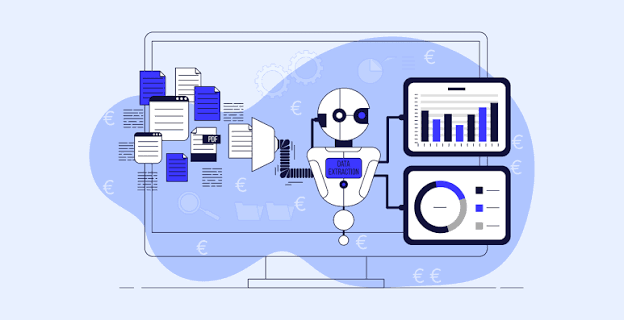
AI connects data from POS systems, e-commerce, inventory platforms, competitor pricing, promotions, customer behavior, and other systems to create a complete view of pricing and sales performance.
2. AI Analyzes Pricing Factors
AI analyzes historical sales, demand, inventory levels, competitor prices, seasonality, promotions, customer behavior, costs, and other factors that can influence the optimal price for a product.
3. Demand & Price Sensitivity Are Predicted
The system predicts how changes in price may affect customer demand, sales volume, revenue, and margins to understand how price-sensitive different products and customers may be.
4. Pricing Opportunities Are Identified
AI identifies opportunities to increase or decrease prices based on demand, competition, inventory, product performance, business objectives, and other pricing rules and constraints.
5. Prices & Promotions Are Optimized
AI recommends optimal prices, markdowns, and promotional offers designed to improve sales, margins, inventory sell-through, or other business goals while maintaining pricing consistency.
6. Performance & Exceptions Are Monitored
The system continuously monitors sales and pricing performance and flags unexpected demand changes, competitor moves, margin risks, pricing inconsistencies, or other conditions requiring attention.
7. Teams Take Action & AI Continues Learning
Employees can review recommendations, approve price changes, and manage exceptions while the AI learns from sales results, customer response, competitive activity, and pricing outcomes to improve future decisions.


Featured Provider: Revionics
Revionics is one of the world's leading AI-powered retail pricing platforms, helping retailers optimize pricing across every stage of the pricing lifecycle. Purpose-built for retail, the platform combines predictive AI, machine learning, advanced analytics, and decades of pricing expertise to deliver intelligent recommendations for everyday pricing, promotions, and markdown optimization. Revionics helps retailers improve margins while maintaining competitive pricing and customer value across stores and digital channels.

Core Benefits
💲 Price Optimization
Uses AI to recommend the optimal everyday price for every product by analyzing demand, customer behavior, inventory levels, and competitive pricing.
📈 Promotion Optimization
Optimizes promotional offers and discounts to increase sales, improve margins, and maximize return on promotional investments.
🎯 Competitive Pricing
Continuously monitors competitor pricing and market conditions to help retailers remain competitive while protecting profitability.
📊 Demand Forecasting
Predicts future product demand using historical sales, seasonality, and market trends to support smarter pricing decisions.
💰 Margin Optimization
Balances sales growth and profitability by recommending prices that maximize gross margin across the entire product assortment.
🌎 Localized Pricing
Automatically adjusts pricing recommendations by store or region based on local demand, competition, and customer purchasing patterns.
Existing Customers


Target Verticals

Other Leading Pricing AI Providers
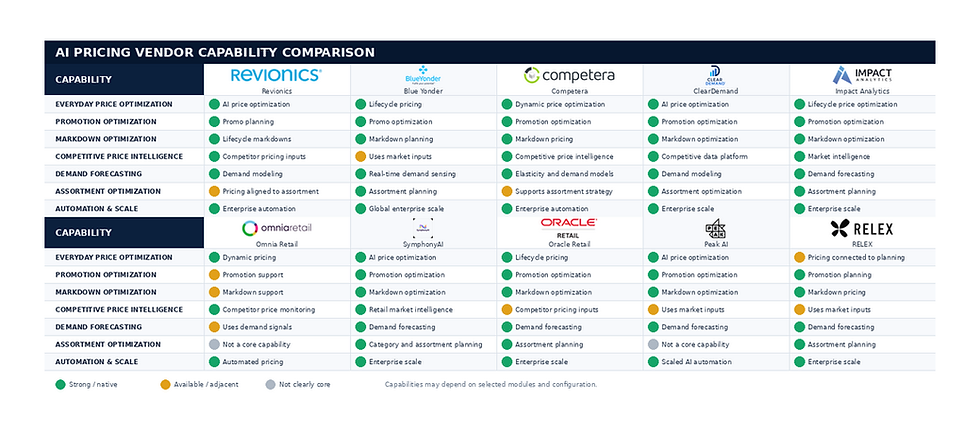
The companies below help retailers optimize pricing decisions with AI-powered demand forecasting, dynamic pricing, promotion optimization, and markdown intelligence.

Blue Yonder

Comptera
Clear Demand
AI-powered retail pricing and lifecycle optimization platform that uses machine learning to optimize everyday pricing, promotions, markdowns, and demand forecasting across enterprise retailers.
AI-powered retail pricing platform that analyzes demand, competitor pricing, customer behavior, and market conditions to deliver optimized pricing recommendations that increase revenue and profitability.
AI-powered retail pricing and promotion optimization platform that helps retailers improve pricing decisions, promotional effectiveness, markdown strategies, and gross margins using predictive analytics and machine learning.
Impact Analytics

Omnia Retail

Symphony AI
AI-native retail pricing and promotions platform that optimizes everyday pricing, promotions, markdowns, demand, inventory and profitability across the product lifecycle.
AI-powered retail pricing platform that combines competitive price intelligence, dynamic pricing, pricing automation and real-time market data to help retailers protect margins and respond quickly to market changes.
AI-powered retail and CPG optimization platform that improves pricing, margins, promotions and category performance using demand forecasting, promotional modeling and real-time retail intelligence.

Oracle Retail
Peak AI

Relex Solutions
AI-powered retail lifecycle pricing platform that uses machine learning to recommend and optimize regular pricing, promotions, markdowns and targeted offers across products, locations and customer segments.
AI-powered pricing platform for retailers and manufacturers that optimizes list prices, promotions and markdowns using demand forecasting, price elasticity and product-level recommendations.
AI-driven retail planning and optimization platform that connects pricing, promotions, markdowns, demand forecasting and inventory data to improve margins, sell-through and promotional performance.