AI Inventory Management for Smarter Retail Operations
Artificial intelligence is transforming retail operations by providing real-time visibility into shelf conditions, inventory accuracy, and store execution. Intelligent shelf monitoring solutions continuously identify out-of-stocks, pricing discrepancies, misplaced products, and merchandising opportunities, allowing retailers to respond faster while improving the shopping experience. By integrating seamlessly with existing retail systems, these AI-powered platforms deliver actionable insights that help optimize labor, increase on-shelf availability, improve inventory accuracy, and maximize sales performance across every location. As retail technology continues to evolve, autonomous shelf intelligence is becoming an essential tool for improving operational efficiency and delivering measurable business outcomes. Reach out to our team to learn more about available AI retail solutions and integration options.

Everything You Need to Know About AI Inventory
AI-powered inventory technology uses artificial intelligence to monitor, analyze, and optimize inventory across the retail operation. AI can forecast demand, automate replenishment, track stock levels, identify inventory issues, and help retailers maintain the right products in the right locations at the right time.
For retailers, the goal isn't simply to automate inventory management. The real opportunity is to create a smarter, more efficient inventory process that improves product availability, reduces stockouts and excess inventory, lowers costs, and allows employees to focus on customers and other higher-value activities.
Questions to Ask Before Choosing a Provider

1.How accurate are the forecasts?
How does the AI improve demand forecasting compared with our current process?
How is forecast accuracy measured, and how quickly does the system adjust when actual demand differs from predictions?
2. Will it integrate with our technology?
Does it integrate with our existing POS, ERP, warehouse, e-commerce, supply chain, and inventory management systems?
What additional integrations or technology will be required?
3. What data does the AI use?
What historical and real-time data is required for the system to work effectively?
Can it incorporate promotions, seasonality, weather, events, trends, supplier lead times, and other external factors?
4. How does it improve replenishment and availability?
How does the AI determine when and how much inventory should be reordered?
Can it identify potential stockouts, overstocks, and slow-moving products before they become larger problems?
5. How much can be automated?
Which inventory decisions can the AI execute automatically, and which require employee approval?
Can we establish different automation rules by product, category, location, or inventory value?
6. What is the business case and ROI?
What is the total cost, including software, implementation, integration, training, and ongoing support?
What measurable improvements should we expect in stockouts, excess inventory, inventory turns, availability, labor, and working capital?
7. Can it reliably scale across our operation?
Can the platform support our number of products, stores, warehouses, and sales channels?
How long does implementation typically take from pilot to full rollout, and what resources will our team need to provide?
Where AI Can improve Inventory

1. Demand Forecasting
AI can analyze historical sales, seasonality, promotions, trends, weather, events, and other demand signals to more accurately predict future inventory needs.
2. Automated Replenishment
AI can recommend or automatically trigger replenishment based on forecasted demand, current inventory, lead times, safety stock levels, and supplier availability.
3. Stockout Prevention
AI can identify products at risk of running out and alert teams or recommend actions before stockouts occur, helping retailers improve product availability and avoid lost sales.
4. Overstock Reduction
AI can identify excess and slow-moving inventory earlier, allowing retailers to adjust purchasing, promotions, markdowns, or transfers before inventory becomes a larger problem.
5. Inventory Allocation & Transfers
AI can determine where inventory is most likely to be needed and recommend how products should be allocated or transferred between stores, warehouses, and fulfillment locations.
6. Inventory Accuracy & Visibility
AI can combine data across stores, warehouses, e-commerce, and other systems to improve inventory visibility and help identify discrepancies between expected and actual inventory.
7. Inventory Analytics & Optimization
Retailers can analyze inventory performance, turnover, availability, stockouts, excess inventory, forecast accuracy, and other metrics to continuously improve inventory decisions.
Key AI Inventory Challenges
1. Data Quality & Accuracy
AI inventory systems depend on accurate sales, inventory, product, supplier, and location data. Incorrect or incomplete data can lead to poor forecasts and inventory recommendations.
2. System IntegrationThe AI must connect effectively with existing POS, ERP, warehouse, e-commerce, supply chain, and inventory management systems to create a reliable view of inventory.
3. Demand Volatility
Unexpected changes in customer demand, weather, trends, promotions, competitive activity, and other external factors can make inventory forecasting difficult even with AI.
4. Supplier & Lead-Time Variability
Supplier delays, changing lead times, product shortages, minimum order quantities, and other supply chain constraints can prevent retailers from acting on AI recommendations.
5. Inventory Visibility
Inventory may be spread across stores, warehouses, distribution centers, and online fulfillment locations. AI is only as effective as the retailer's ability to accurately identify what inventory is available and where it is located.
6. Automation vs. Human Oversight
Not every inventory decision should be automated. Retailers need to determine which recommendations AI can execute automatically and when employees should review or override decisions.
7. Employee Adoption & Change Management
Merchants, planners, store teams, and supply chain employees need to understand how the technology works, when to trust its recommendations, and how their responsibilities change as AI becomes more involved in inventory decisions.
How AI Inventory Works
1. Inventory Data is Collected
AI connects data from POS systems, inventory platforms, warehouses, stores, suppliers, e-commerce, and other systems to create a more complete view of inventory across the business.
2. AI Analyzes Data
AI analyzes historical sales, current trends, seasonality, promotions, locations, weather, events, and other factors to predict how much inventory will be needed and where.
3. Inventory Levels Are Continuously Monitored
The system tracks inventory levels across stores, warehouses, distribution centers, and online channels to identify potential stockouts, excess inventory, and other inventory issues.
4. Replenishment Needs Are Identified
AI determines when products should be reordered or transferred based on expected demand, current inventory, lead times, safety stock, supplier availability, and other business rules.
5. Inventory Is Optimized Across Locations
AI can recommend how inventory should be allocated or transferred between stores, warehouses, and fulfillment locations to put products where they are most likely to sell.
6. Exceptions & Risks Are Flagged
The system identifies unusual inventory conditions such as unexpected demand changes, slow-moving products, overstocks, potential stockouts, supplier delays, or discrepancies that require attention.
7. Teams Take Action & AI Continues Learning
Employees can review recommendations, approve actions, and manage exceptions while the AI continuously learns from sales, inventory movements, demand patterns, and outcomes to improve future forecasts and decisions.

Featured Provider: Simbe Robotics


Simbe Robotics is a leader in autonomous shelf intelligence, helping retailers improve inventory accuracy, merchandising compliance, pricing integrity, and overall store execution through AI-powered robotics. Simbe's flagship autonomous robot, Tally, continuously scans store shelves to identify out-of-stocks, misplaced items, pricing discrepancies, and planogram compliance issues in real time. By integrating with existing retail systems, Simbe delivers actionable analytics that enable retailers to increase product availability, improve labor efficiency, reduce inventory shrink, and create a better shopping experience while driving measurable operational improvements.
Core Benefits
🤖 Autonomous Shelf Intelligence
Continuously scans store shelves to identify out-of-stocks, misplaced products, pricing errors, and merchandising issues
📦 Inventory Accuracy
Delivers near real-time visibility into inventory conditions, helping retailers maintain accurate stock levels and reduce inventory discrepancies.
🛒 Out-of-Stock Detection
Quickly identifies empty shelves and replenishment opportunities, allowing associates to restock products before sales are lost.
🏷️ Pricing & Promotion Compliance
Automatically verifies shelf labels, promotional pricing, and product placement to improve pricing accuracy and reduce compliance issues.
📐 Planogram Compliance
Ensures products are displayed according to merchandising standards, improving store consistency and maximizing product visibility.
👥 Labor Optimization
Automates repetitive shelf audits, allowing store associates to focus on customer engagement and other higher-value activities.
Existing Customers




Target Verticals

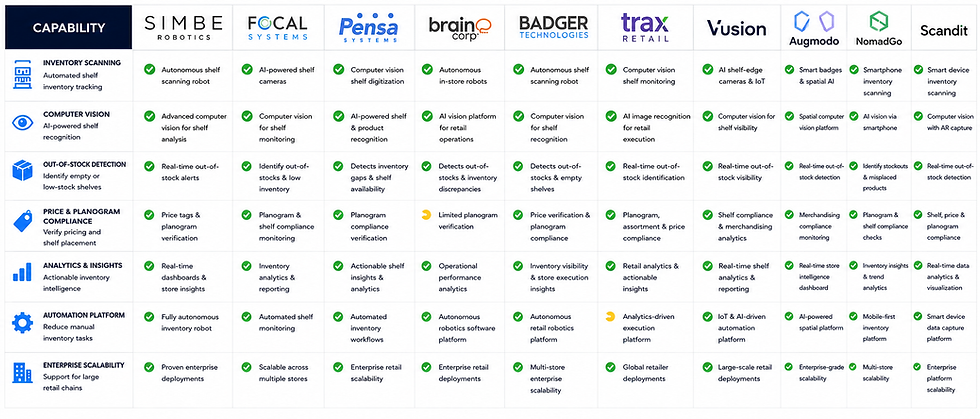
Other Leading Inventory AI Providers
The companies below help retailers modernize inventory management with AI-powered shelf monitoring, inventory automation, real-time analytics, and out-of-stock detection.

Badger Technologies
AI-powered autonomous robots that automate inventory scanning, out-of-stock detection, price verification, and hazard identification to improve store operations.
Focal Systems
AI-powered shelf cameras and computer vision that continuously monitor product availability, identify out-of-stocks and low inventory, automate replenishment workflows, and improve inventory accuracy. accuracy.
Augmodo
AI-powered smart badges and spatial computing that passively map store shelves, track product availability and out-of-stocks, monitor merchandising compliance, and provide real-time store intelligence.



Brain Corp
AI software platform powering autonomous inventory and floor-care robots that collect shelf data while automating routine retail operations.
Trax Retail

NomadGo
AI-powered spatial vision that uses smartphones and tablets to rapidly count inventory, identify stockouts and misplaced products, monitor planogram compliance, and improve replenishment and ordering.

AI-powered computer vision and image recognition that monitor product availability, placement, assortment, pricing, and promotions while identifying shelf gaps and improving retail execution.

Pensa Systems
AI-powered inventory intelligence platform using autonomous drones and computer vision to deliver highly accurate shelf inventory and merchandising insights.
Vusion
AI-powered shelf-edge cameras and computer vision that provide real-time shelf visibility, automatically identify products and out-of-stocks, improve replenishment, and increase on-shelf availability.
Scandit
AI-powered smart-device scanning and computer vision that provide real-time inventory visibility, detect out-of-stocks, trigger replenishment workflows, and improve shelf, price, and planogram compliance.