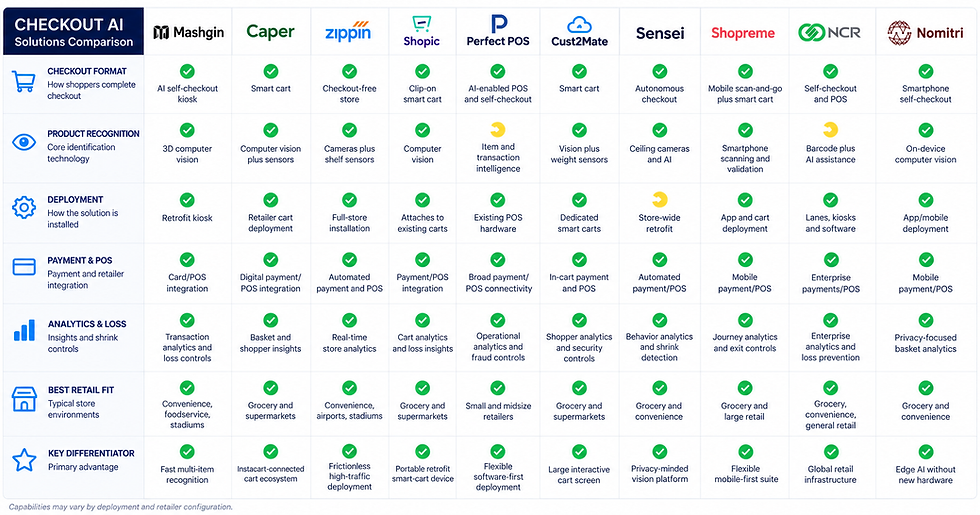
AI Checkout Solutions for Retail
Traditional checkout processes can create long lines, slow transaction times, increase labor demands, and frustrate customers during peak shopping periods. AI-powered checkout solutions simplify the purchasing process by recognizing products automatically and reducing or eliminating the need for individual barcode scanning.
Using technologies such as computer vision, intelligent self-checkout, smart carts, and autonomous checkout, these platforms allow customers to complete purchases more quickly and with less effort. Retailers can increase transaction throughput, reduce abandoned purchases, improve checkout accuracy, and redeploy employees to higher-value customer service activities.
AI checkout is particularly valuable in high-volume environments such as convenience stores, airports, stadiums, cafeterias, healthcare facilities, grocery stores, and quick-service restaurants where speed, accuracy, and ease of use directly affect the customer experience.
Everything You Need to Know About using AI in Checkout
AI-powered checkout technology uses artificial intelligence to identify products, automate transactions, detect items, recognize customer actions, and help retailers create faster and more efficient checkout experiences. AI can power computer vision checkout, smart carts, self-checkout monitoring, frictionless stores, automated product recognition, and other technologies that simplify the purchasing process.
For retailers, the goal isn't simply to remove traditional checkout lanes or reduce cashier involvement. The real opportunity is to create a faster, more convenient checkout experience that reduces friction, improves transaction accuracy, increases throughput, helps prevent loss, improves employee productivity, and gives customers more flexible ways to complete their purchases.

How AI in Checkout Works
Where AI Can improve Checkout

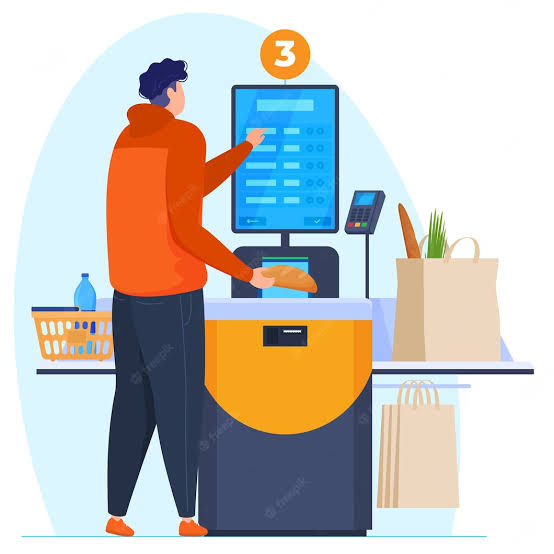
1. Items Are Identified & Captured
AI-powered checkout uses computer vision, cameras, sensors, scanners, RFID, or other technologies to identify the products customers select, scan, place in a cart, or bring to the checkout area.
2. Products & Transactions Are Verified
The system compares identified items with product catalogs, pricing, weight, images, transaction data, and other information to confirm the correct products and quantities are being purchased.
3. Customer Actions Are Monitored
AI analyzes activity throughout the checkout process to recognize when products are added, removed, exchanged, missed, or incorrectly scanned and identify transactions that may require additional attention.
4. Checkout Friction Is Reduced
AI can automate product recognition, reduce manual scanning, identify produce or other items, and enable self-checkout, smart carts, or checkout-free experiences that allow customers to complete purchases faster.
5. Errors & Potential Loss Are Identified
The system can detect missed scans, incorrect barcodes, product switching, unusual transactions, or other behaviors that may indicate an accidental checkout error or potential theft.
6. Employees Manage Exceptions
When AI detects an uncertain item, transaction error, age-restricted product, payment issue, or suspicious activity, employees can be alerted to review the transaction and assist the customer when necessary.
7. Transactions Improve Future PerformanceThe system analyzes checkout activity, product recognition, interventions, transaction outcomes, and customer behavior to improve accuracy while retailers use the insights to reduce shrink, improve checkout speed, and optimize operations.
1. Faster Checkout
AI can automate product identification, scanning, and transaction processing, helping customers complete purchases faster while reducing lines, wait times, and friction at traditional and self-checkout lanes.
2. Automated Product Recognition
AI-powered computer vision can automatically recognize products, produce, and other items without requiring customers or employees to manually search for product codes or scan every barcode.
3. Self-Checkout Accuracy
AI can monitor self-checkout transactions to identify missed scans, incorrect items, product switching, and other errors, helping retailers improve transaction accuracy while reducing unnecessary employee interventions.
4. Shrink & Loss Prevention
AI can identify suspicious checkout behavior, missed scans, barcode switching, concealed merchandise, and other potential loss events, helping retailers reduce shrink while allowing legitimate customers to shop normally.
5. Checkout-Free Shopping
AI can use cameras, sensors, computer vision, and other technologies to automatically identify what customers take and enable purchases without requiring shoppers to use a traditional checkout lane.
6. Employee Productivity
AI can automate routine checkout tasks and prioritize transactions that actually require assistance, allowing employees to manage more checkout stations while spending less time responding to unnecessary alerts.
7. Checkout Analytics & Performance
Retailers can analyze checkout speed, wait times, interventions, transaction errors, shrink events, customer behavior, and other metrics to identify operational issues and continuously improve the checkout experience.
Questions to Ask Before Choosing a Provider

1. How accurate is the AI checkout technology?
How accurately does the AI identify products, customer actions, missed scans, and potential checkout errors?
How is accuracy measured, and what results have similar retailers achieved in real-world store environments?
2. Will it integrate with our technology?
Does it integrate with our existing POS, payment, inventory, loyalty, security, and store systems?
What additional cameras, sensors, hardware, integrations, or technology will be required at each location?
3. How does it improve the checkout experience?
How does the AI reduce checkout time, customer wait times, scanning requirements, and employee interventions?
Can it support self-checkout, traditional checkout, smart carts, checkout-free shopping, or other checkout formats?
4. How does it help reduce shrink and errors?
How does the AI identify missed scans, product switching, incorrect items, suspicious behavior, and other potential loss events?
How accurately can it distinguish between legitimate mistakes and potential theft?
5. How are exceptions and false alerts handled?
What situations require employee intervention, and how are employees notified?
How does the system minimize false alerts and unnecessary interventions while ensuring legitimate checkout issues are quickly identified and resolved?
6. What is the business case and ROI?
What is the total cost, including software, cameras, hardware, implementation, integration, training, and ongoing support?
What measurable improvements should we expect in checkout speed, shrink, transaction accuracy, labor productivity, and customer satisfaction?
7. Can it reliably scale across our operation?
Can the platform support our number of stores, checkout lanes, products, transactions, and different store formats?
How long does implementation typically take from pilot to full rollout, and what resources will our team need to provide?
Key AI Checkout Challenges
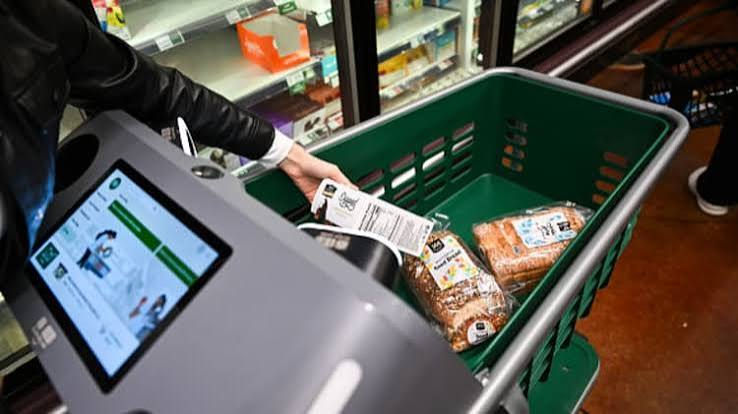
1. Product Recognition & Accuracy
AI checkout systems need to accurately identify products, quantities, barcodes, produce, and customer actions. Similar-looking items, obstructed products, unusual packaging, or poor camera visibility can lead to incorrect transactions or unnecessary alerts.
2. System Integration
The AI must connect effectively with existing POS, payment, inventory, loyalty, security, and store systems to ensure transactions are processed accurately and information remains current across the retail operation.
3. Customer Behavior & Exceptions
Customers may scan, move, remove, exchange, or handle products in unexpected ways. AI needs to distinguish normal shopping behavior from checkout errors or suspicious activity without creating unnecessary friction.
4. Shrink Detection & False Alerts
AI can help identify missed scans, product switching, and other potential loss events, but too many false alerts can frustrate customers and employees. Retailers need to balance loss prevention with a smooth checkout experience.
5. Privacy & Customer Trust
Computer vision, cameras, sensors, and other AI technologies can raise customer concerns about surveillance and personal data. Retailers need clear policies for how information is collected, stored, protected, and used.
6. Automation vs. Human Oversight
Not every checkout situation can be handled automatically. Retailers need to determine when AI can complete transactions or resolve issues and when employees should intervene for exceptions, disputes, restricted products, or other situations.
7. Implementation & Employee Adoption
AI checkout may require new cameras, sensors, hardware, store layouts, integrations, and employee processes. Retailers need to manage implementation carefully while training employees to understand alerts, assist customers, and work effectively with the technology.

Top Benefits
⚡ Lightning-Fast Checkout
Recognizes multiple items simultaneously without barcode scanning, reducing checkout times to just a few seconds.
👁️ Advanced Computer Vision
Uses AI-powered cameras to instantly identify products regardless of orientation or packaging placement.
💰 Lower Labor Costs
Allows retailers to redeploy associates to higher-value customer service activities while increasing transaction throughput.
Featured Provider:
Mashgin
Mashgin is the global leader in AI-powered self-checkout technology. Its patented computer vision platform recognizes multiple items simultaneously without requiring customers to scan barcodes. By combining advanced cameras, artificial intelligence, and machine learning, Mashgin delivers one of the fastest checkout experiences available today—often completing transactions in less than 10 seconds.
Unlike traditional self-checkout systems, Mashgin requires minimal customer interaction, creating a frictionless purchasing experience while helping retailers improve operational efficiency and customer satisfaction.
📈 Higher Revenue
Shorter wait times reduce abandoned purchases and encourage additional transactions during busy periods.
😊 Improved Customer Experience
Provides an intuitive, frictionless checkout process that minimizes customer frustration and long checkout lines.
🔄 Easy Integration
Integrates with existing POS systems and payment solutions while requiring minimal changes to store operations.

Existing Customers


Target Verticals

Other Leading Checkout AI Providers
The companies below help retailers enhance the shopping experience with AI-powered smart carts, autonomous checkout, computer vision, and intelligent frictionless checkout solutions.

Caper by Instacart

Zippin

Shopic
AI-powered smart carts and computer vision to automatically identify products and streamline the checkout process. Designed for grocery retailers, the platform reduces wait times, enhances the shopping experience, and provides valuable real-time retail analytics.
Zippin uses computer vision, shelf sensors, and AI to eliminate traditional checkout lanes. It's widely used in convenience stores, sports venues, airports, hospitals, and micro-markets to deliver frictionless shopping experiences.
Shopic uses clip-on AI devices with computer vision to convert existing shopping carts into smart carts that automatically recognize products, guide shoppers, and enable fast checkout while providing retailers with valuable shopping analytics.

Perfect POS

Cust2Mate

Sensei
Cloud-based point-of-sale and retail management platform connecting checkout, inventory, purchasing, e-commerce, customer engagement, and analytics. Designed for independent retailers, Perfect POS simplifies everyday store operations, provides real-time business insights, improves inventory control, and helps retailers make smarter decisions.
AI-powered smart carts and computer vision to automatically identify products and streamline the checkout process. Designed for grocery retailers, the platform reduces wait times, enhances the shopping experience, and provides valuable real-time retail analytics.
AI-powered autonomous retail platform using computer vision to eliminate traditional scanning and checkout lines. Designed for supermarkets, convenience stores, airports, service stations, and other retail environments, Sensei tracks product activity, supports automated payments, improves shelf visibility, reduces theft, and provides operational insights.

Shopreme

NCR Voyix

Nomitri
Self-checkout platform combining mobile Scan & Go, smart carts, kiosks, payment, loss prevention, and retail analytics. Designed for grocery and other physical retailers, Shopreme integrates with existing POS systems to reduce checkout lines, increase shopper convenience, personalize promotions, and improve store operations.
Unified commerce platform providing point-of-sale, self-checkout, payments, loyalty, and AI-powered retail applications. Designed for enterprise retailers and restaurants, the platform improves checkout efficiency, reduces shrink, personalizes customer experiences, and connects store operations across physical and digital channels.
Mobile AI self-checkout platform that uses computer vision to recognize products directly through a shopper’s smartphone. Designed for grocery and convenience retailers, Nomitri can be integrated without extensive store modifications, helping reduce checkout lines, improve shopping convenience, and lower the cost of introducing autonomous checkout.