
AI Workforce Management Solutions for Smarter Retail Operations
AI-powered workforce management solutions are transforming how retailers forecast labor needs, schedule employees, manage labor costs, and improve frontline productivity.
By analyzing sales trends, customer traffic, historical demand, employee availability, skills, and operational requirements, AI-powered workforce management platforms help retailers align staffing levels with actual business demand. Automated scheduling and real-time workforce insights allow managers to spend less time on administrative tasks while ensuring stores have the right employees in the right place at the right time.
As retailers face rising labor costs, changing customer demand, and increasing pressure to improve employee retention, AI workforce management is becoming an important tool for improving operational efficiency while creating a better experience for both employees and customers.

Everything You Need to Know About AI Workforce Management
AI-powered workforce management uses artificial intelligence to forecast labor demand, optimize employee schedules, manage staffing levels, automate workforce processes, and help retailers match the right employees with the right work at the right time. AI can analyze sales, customer traffic, labor requirements, employee availability, skills, historical trends, seasonality, and other operational data to improve workforce planning and execution.
For retailers, the goal isn't simply to automate scheduling or reduce labor costs. The real opportunity is to create a smarter, more flexible workforce strategy that improves staffing accuracy, increases employee productivity, reduces unnecessary labor expenses, improves employee experiences, strengthens customer service, and helps stores respond faster to changing business conditions.
Questions to Ask Before Choosing a Provider

1.How accurate are the labor forecasts?
How does the AI improve labor forecasting compared with our current process?
How is forecast accuracy measured, and what results have similar retailers achieved in staffing accuracy, labor costs, productivity, and service levels?
2. Will it integrate with our technology?
Does it integrate with our existing POS, payroll, HR, time and attendance, scheduling, workforce management, and other systems? What additional integrations or technology will be required?
3. What data does the AI use?
What historical and real-time data is required for the system to work effectively?
Can it incorporate sales, customer traffic, employee availability, skills, labor costs, promotions, weather, events, seasonality, and other demand factors?
4. How does it optimize staffing and schedules?
How does the AI determine staffing requirements and create schedules?
Can it balance forecasted demand, employee availability, skills, preferences, labor budgets, service goals, and other business requirements?
5. How does it handle changes, rules, and exceptions?
Can the system adjust to callouts, demand changes, open shifts, overtime, and unexpected staffing needs?
How does it manage labor laws, scheduling rules, employee preferences, and manager overrides?
6. What is the business case and ROI?
What is the total cost, including software, implementation, integration, training, and ongoing support?
What measurable improvements should we expect in labor costs, scheduling efficiency, productivity, employee retention, and customer service?
7. Can it reliably scale across our operation?
Can the platform support our number of employees, stores, departments, markets, and scheduling requirements?
How long does implementation typically take from pilot to full rollout, and what resources will our team need to provide?
Where AI Can improve Workforce Management

1. Labor Demand Forecasting
AI can analyze sales, customer traffic, seasonality, promotions, weather, events, and historical patterns to predict staffing needs and help retailers schedule the right number of employees at the right times.
2. Employee Scheduling
AI can automatically create optimized schedules based on forecasted demand, employee availability, skills, preferences, labor budgets, operating hours, and scheduling requirements while reducing time spent manually building schedules.
3. Labor Cost Optimization
AI can help retailers balance staffing requirements with labor budgets by identifying overstaffing, unnecessary overtime, scheduling inefficiencies, and other opportunities to control costs without negatively affecting customer service.
4. Real-Time Staffing Adjustments
AI can monitor sales, customer traffic, workload, callouts, and other changing conditions and recommend staffing adjustments, shift changes, or additional coverage when actual demand differs from forecasts.
5. Employee Availability & Flexibility
AI can help manage employee availability, time-off requests, open shifts, and shift swaps while matching available employees with staffing needs and providing workers with greater scheduling flexibility.
6. Workforce Productivity
AI can analyze staffing levels, workloads, employee skills, task requirements, and performance trends to help retailers better allocate employees and improve productivity across stores, departments, and shifts.
7. Employee Experience & Retention
AI can help create more predictable and flexible schedules, consider employee preferences, reduce scheduling conflicts, and improve communication, helping retailers increase employee satisfaction and potentially reduce turnover.
Key AI Workforce Management Challenges

1. Data Quality & Accuracy
AI workforce management depends on accurate sales, traffic, labor, scheduling, availability, and historical data. Incomplete or inaccurate information can lead to poor demand forecasts and staffing recommendations.
2. System Integration
The AI must connect effectively with existing POS, payroll, time and attendance, scheduling, HR, workforce management, and other systems to ensure staffing decisions are based on complete and current information.
3. Unpredictable Labor Demand
Customer traffic, sales, weather, promotions, events, callouts, and other factors can change unexpectedly, making it difficult for AI to always predict the right staffing levels for every location and shift.
4. Employee Availability & Preferences
Employees have different availability, skills, scheduling preferences, time-off requests, and personal circumstances. Retailers need to balance optimized staffing with creating schedules that are practical and fair for employees.
5. Labor Rules & Compliance
Schedules must account for overtime, breaks, minimum hours, predictive scheduling requirements, union rules, employee classifications, and other labor regulations that may vary across locations and markets.
6. Automation vs. Manager Oversight
Not every staffing decision should be automated. Retailers need to determine which scheduling and workforce decisions AI can make automatically and when managers should review recommendations, handle exceptions, or override the system.
7. Employee Adoption & Change Management
Managers and employees need to understand how AI-generated schedules and recommendations work, when to trust them, and how to use new workforce tools effectively while adapting to changes in existing scheduling processes.
How AI Worforce Management Works

1. Workforce Data is Collected
AI connects data from POS, workforce management, payroll, scheduling, time and attendance, employee availability, customer traffic, and other systems to understand staffing needs and workforce performance.
2. Labor Demand is Forecasted
The system analyzes historical sales, customer traffic, seasonality, promotions, events, weather, and other factors to predict when and where employees will be needed across stores and departments.
3. Staffing Requirements Are Determined
AI translates demand forecasts into staffing requirements based on expected workload, employee skills, labor standards, operating hours, service goals, and other business requirements.
4. Employee Schedules Are Optimized
The system creates or recommends schedules that match staffing demand with employee availability, skills, preferences, labor costs, and scheduling rules while helping retailers avoid overstaffing or understaffing.
5. Real-Time Changes Are Managed
AI monitors changing sales, traffic, employee callouts, workload, and other conditions throughout the day and can recommend schedule adjustments, shift changes, or additional staffing when needed.
6. Employees & Managers Take Action
Employees can view schedules, request time off, swap shifts, update availability, and receive notifications while managers review recommendations, approve changes, manage exceptions, and address staffing issues.
7. Workforce Performance Continues to Improve
The system analyzes labor costs, staffing levels, schedule effectiveness, employee availability, sales, and customer demand to improve future forecasts while helping retailers continuously optimize workforce decisions.

Featured Provider:
Legion


Legion provides an AI-powered workforce management platform designed to help retailers optimize labor efficiency while improving the frontline employee experience. Its platform combines AI-driven demand forecasting, labor planning, automated scheduling, workforce optimization, employee engagement, and compliance capabilities.
Legion uses AI to help retailers predict workforce demand and create optimized schedules that consider business needs, labor budgets, employee skills, availability, scheduling preferences, and compliance requirements.
Top Benefits
📊 Smarter Labor Forecasting
AI analyzes sales, traffic, historical patterns, and other demand drivers to predict staffing requirements.
📅 Optimized Employee Scheduling
Automatically creates schedules based on business demand, employee availability, skills, labor budgets, and scheduling requirements.
💰 Reduced Labor Costs
Helps retailers align scheduled hours with demand while reducing unnecessary overtime and overstaffing.
😊 Improved Employee Experience
Provides employees with greater schedule visibility, flexibility, shift-swapping, and self-service capabilities.
⚡ Increased Manager Productivity
Automates scheduling and workforce administration so managers can spend more time supporting employees and customers.
✅ Labor Compliance
Helps retailers manage scheduling rules, overtime, labor requirements, and workforce compliance.
Existing Customers


Target Verticals

Other Leading AI Workforce Management Providers
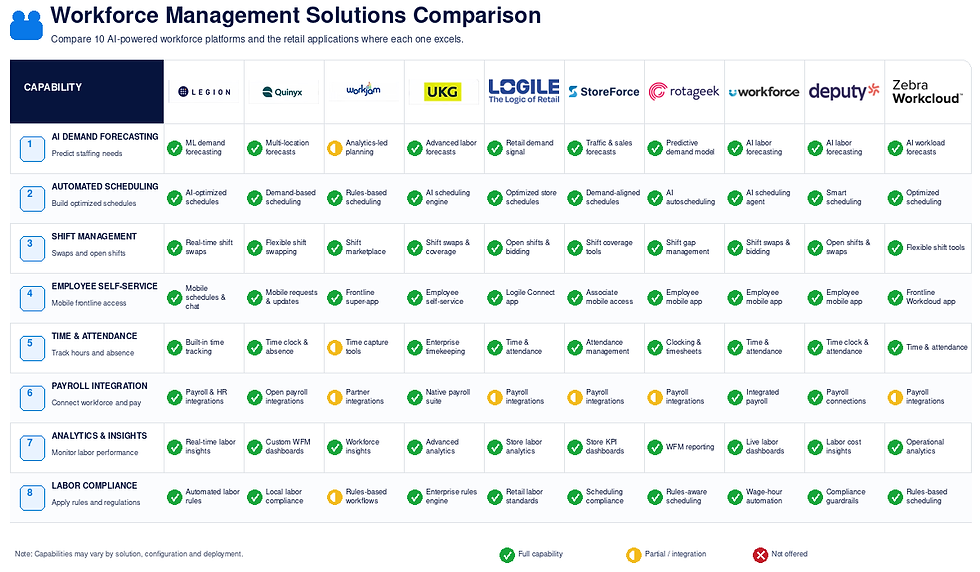
The companies below help retailers improve labor forecasting, employee scheduling, workforce productivity, employee engagement, and frontline operations with AI-powered workforce management technology.

UKG

Quinyx

WorkJam
AI-powered workforce management platform that helps retailers manage labor forecasting, scheduling, time and attendance, workforce analytics, payroll, and employee experiences.
AI-powered workforce management platform that helps retailers forecast labor demand, optimize employee schedules, control labor costs, manage compliance, and provide frontline employees with flexible scheduling tools.
Frontline workforce platform that combines employee scheduling, shift management, task management, communications, training, and workforce orchestration to help retailers improve frontline execution and employee engagement.

Logile

Storeforce

Rotageek
AI-powered workforce management platform that helps retailers improve labor forecasting, planning, scheduling, time and attendance, task management, store execution, and workforce productivity.
AI-powered retail workforce management platform that connects labor forecasting, employee scheduling, task management, store communication, performance analytics, and real-time sales and traffic data.
AI-powered retail workforce management platform that connects labor forecasting, employee scheduling, task management, store communication, performance analytics, and real-time sales and traffic data.

Workforce.com

Deputy

Zebra Workcloud
AI-powered workforce management platform that helps retailers manage labor forecasting, employee scheduling, time and attendance, workforce compliance, HR, payroll, and frontline team communication.
AI-powered workforce management platform that helps retailers forecast labor demand, build employee schedules, track attendance, control labor costs, manage compliance, communication, HR, and payroll.
AI-powered workforce optimization platform that helps retailers manage labor forecasting, budgeting, employee scheduling, task execution, workforce analytics, frontline communication, productivity, and customer service.
.png)